


Many of our big band songs are arrangements of classic hymns. From time to time, we will post the stories behind the hymns and hymntunes.
The hymn “Praise Ye the Lord, the Almighty” is one of the most beloved traditional Christian hymns. It’s history dates back more than 300 years.
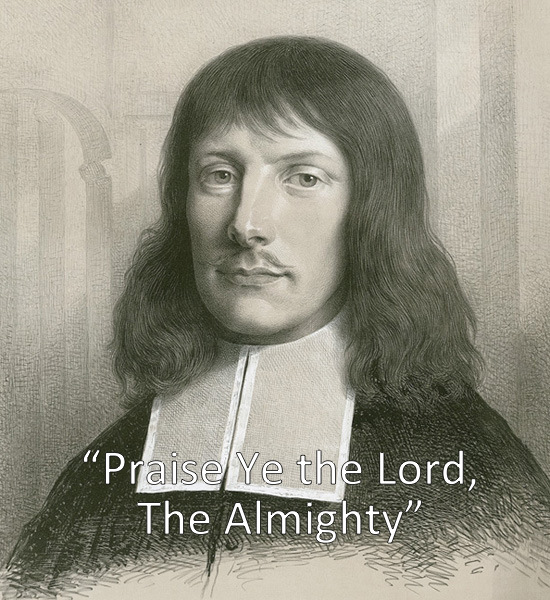
The lyrics were originally written in German by Joachim Neander around 1680. Several of his ancestors were ministers, two of whom also were named Joachim Neander. The legend behind the hymn is that Joachim, the author, came with a group of rowdy youths to St. Martin’s Church in Bremen one day intending to harass the attendees. Instead, the sermon he heard affected him spiritually. Ironically, he later served at that church as assistant pastor. Neander died at the age of 30 of complications of tuberculosis.
The original title was “Lobe den Herren, den mächtigen König der Ehren” (“Praise to the Lord, the Mighty King of Honor”). Neander was a Reformed (Calvinist) Protestant teacher and hymn writer. Many of his hymns were written to emphasize God’s power and care, though “Praise Ye the Lord, the Almighty” may be the most enduring of his 60 hymns.
The tune most often paired with the hymn is called “Lobe den Herren”, a traditional German melody that predates Neander slightly (published in the 17th century). Its strong, joyful rhythm contributes to the hymn’s uplifting and triumphant feel.
The translation of Neander’s hymn into English is attributed to Catherine Winkworth in the 19th Century. Winkworth is one of the most important translators of German hymns. Her 1863 version is the one most commonly sung today.
“To God be the glory.”
 Dallas Christian Jazz Band
Leave a comment